5 computing trends in agriculture worth watching
Why this matters
Agriculture is going through a transformation increasingly driven by data, connectivity, and automation. In recent years, topics such as artificial intelligence, sensors, computer vision, and platform integration have moved beyond promising concepts and become part of concrete discussions about productivity, sustainability, and decision-making in the field. FAO has been treating digital agriculture and AI as relevant parts of innovation in agrifood systems, while the OECD highlights the advance of these technologies in applications such as monitoring, management, and forecasting.
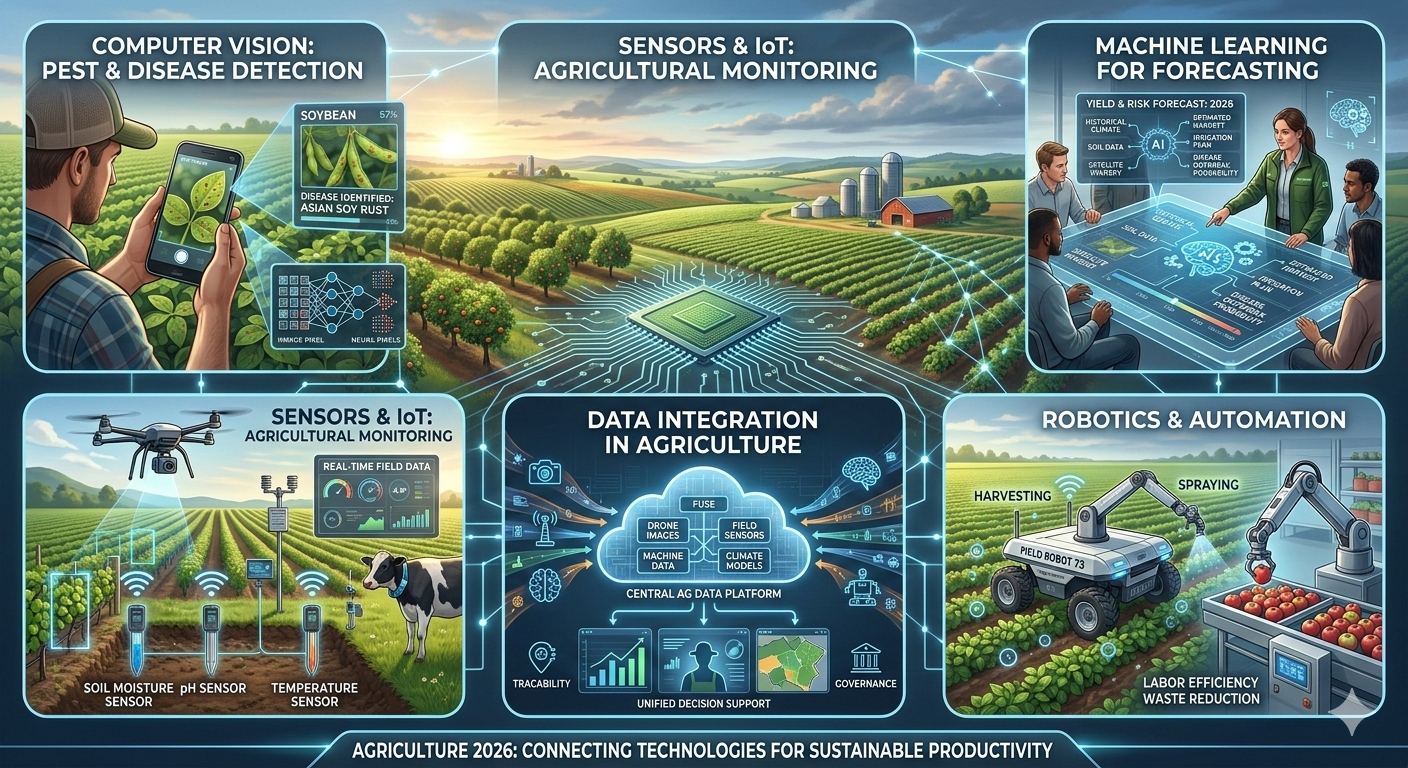
More than adopting isolated tools, the current challenge is understanding how these technologies connect and where they truly deliver value. In 2026, five topics deserve special attention because they frequently appear in both institutional reports and recent technical reviews: computer vision, sensors and IoT, machine learning for forecasting, robotics and automation, and data integration.
Practical challenges
For a long time, agricultural decisions relied on manual observation, empirical knowledge, and occasional measurements. These elements remain important, but they are no longer enough on their own in the face of more complex scenarios such as climate variability, the need to reduce waste, labor shortages, and pressure for greater efficiency. The opportunity lies in using computing not as a replacement for agronomic knowledge, but as an expansion of the ability to monitor, predict, and act more precisely.
At the same time, it is easy to fall into exaggeration. Not every technological novelty is ready for broad adoption, and many solutions still face limitations related to cost, connectivity, data standardization, and validation under real field conditions. That is why these topics are best approached with balance: neither hype nor rejection.
Five trends to watch
1. Computer vision for detecting diseases and pests
Computer vision stands out as one of the most visible areas of computing applied to agriculture. The principle is relatively simple: use images captured by phones, cameras, drones, or smart traps to identify patterns associated with diseases, stress, or pest presence. Recent reviews show that deep learning models have achieved good results in tasks such as leaf disease classification, visual detection, and automated screening of agricultural images.
In practice, this can help speed up monitoring and support faster decisions. But there are still important limitations: performance outside the training dataset, lighting variation, similarity between symptoms, and the need for well-annotated data. In other words, it is a promising technology, but one that requires context and local validation.
2. Sensors and IoT in agricultural monitoring
Sensors and the Internet of Things form the foundation of much of digital agriculture. Soil moisture, temperature, pH, plant stress, and climate sensors make it possible to monitor the environment more continuously, generating real-time data for irrigation, fertigation, crop management, and alerts. Recent reviews point to this set of technologies as one of the pillars of precision agriculture, especially when connected to platforms capable of turning measurements into actions.
The value here is not only in “measuring more,” but in measuring better and frequently enough to reduce decisions based solely on estimation. Even so, challenges such as rural connectivity, device maintenance, cost, and interoperability remain decisive and still limit large-scale adoption.
3. Machine learning for forecasting
If sensors help observe, machine learning helps anticipate. Predictive models are used to estimate yield, irrigation needs, disease occurrence, climate risks, and operational efficiency. Interest in this topic continues to grow because it fits well within a more data-driven agriculture that is less dependent on delayed reaction. The OECD highlights the use of AI in applications such as pest control, soil monitoring, and optimization of agricultural operations.
The potential is high, but the critical point is the quality of the input data. Bad models trained on bad data only automate error. That is why machine learning in agriculture makes more sense when it comes with strong data collection, curation, and technical interpretation.
4. Robotics and automation
Agricultural robotics is no longer just a futuristic idea; it has become an active field of research, testing, and commercial applications. Recent reviews of field robots show growing use in tasks such as spraying, harvesting, autonomous navigation, inspection, and repetitive operations. This advance directly addresses a practical issue: labor shortages, the need for precision, and waste reduction.
Still, the real-world scenario is more complex than the promise. Safety, cost, autonomy, robustness in open environments, and adaptation to different crops remain central factors. Even so, this is a topic worth watching because automation tends to gain ground first in specific tasks and then in more integrated workflows.
5. Data integration in agriculture
Perhaps the least flashy topic, but one of the most important. It is not enough to have sensors, drones, software, machines, and forecasting models if each system speaks a different language. Data integration is what allows isolated tools to become real decision support. Recent World Bank reports on digital agriculture and traceability reinforce the importance of platforms, data governance, and interoperability to generate consistent value in the agrifood sector.
This topic also connects to an important debate: who controls the data, how it flows, and to what extent farmers depend on closed platforms. Therefore, discussing integration is not just about technology, but also about architecture, standards, and informational sovereignty in the field.
What to watch next
More than adopting isolated technologies, what is gaining strength in 2026 is the integration of different fronts of digital agriculture into the same monitoring and decision-making flow. Computer vision, sensors and IoT, machine learning, robotics, and data integration should not be seen as separate trends, but as complementary parts of a broader system. In this context, the value lies not only in collecting data or automating tasks, but in turning information into real support for faster and more accurate decisions.
This integration also shows that the future of digital agriculture depends less on “magic” tools and more on reliable ecosystems in which well-collected data, connectivity, interoperability, and intelligent use of AI work together. When these five trends are brought closer to real field problems, the potential for improvement becomes even greater, especially when artificial intelligence is combined with the technical knowledge and decision-making of field professionals and computer scientists. This connection between practical experience, agronomic knowledge, and technology can accelerate important advances in monitoring, forecasting, and response to agricultural events.
References
-
Upadhyay, A., Chandel, N. S., Singh, K. P. et al. Deep learning and computer vision in plant disease detection: a comprehensive review of techniques, models, and trends in precision agriculture. Artificial Intelligence Review, 58, 92, 2025. https://doi.org/10.1007/s10462-024-11100-x
-
FAO. Digital Agriculture and AI Innovation Roadmap. Food and Agriculture Organization of the United Nations.
-
OECD. AI in agriculture. In: Progress in Implementing the European Union Coordinated Plan on Artificial Intelligence, Volume 2. Organisation for Economic Co-operation and Development, 18 Feb. 2026.
-
World Bank. Implementation of Public Agrifood Digital Traceability Platforms.
-
World Bank. A Digital Public Infrastructure Approach for the Agriculture Sector. 2025/2026.
-
Miller, T. et al. The IoT and AI in Agriculture: The Time Is Now—A Systematic Review. Sensors, v. 25, n. 12, 2025.
-
Manono, B. O. et al. Precision Farming with Smart Sensors: Current State, Challenges, and Future Directions. Sensors, v. 26, n. 3, 2026.